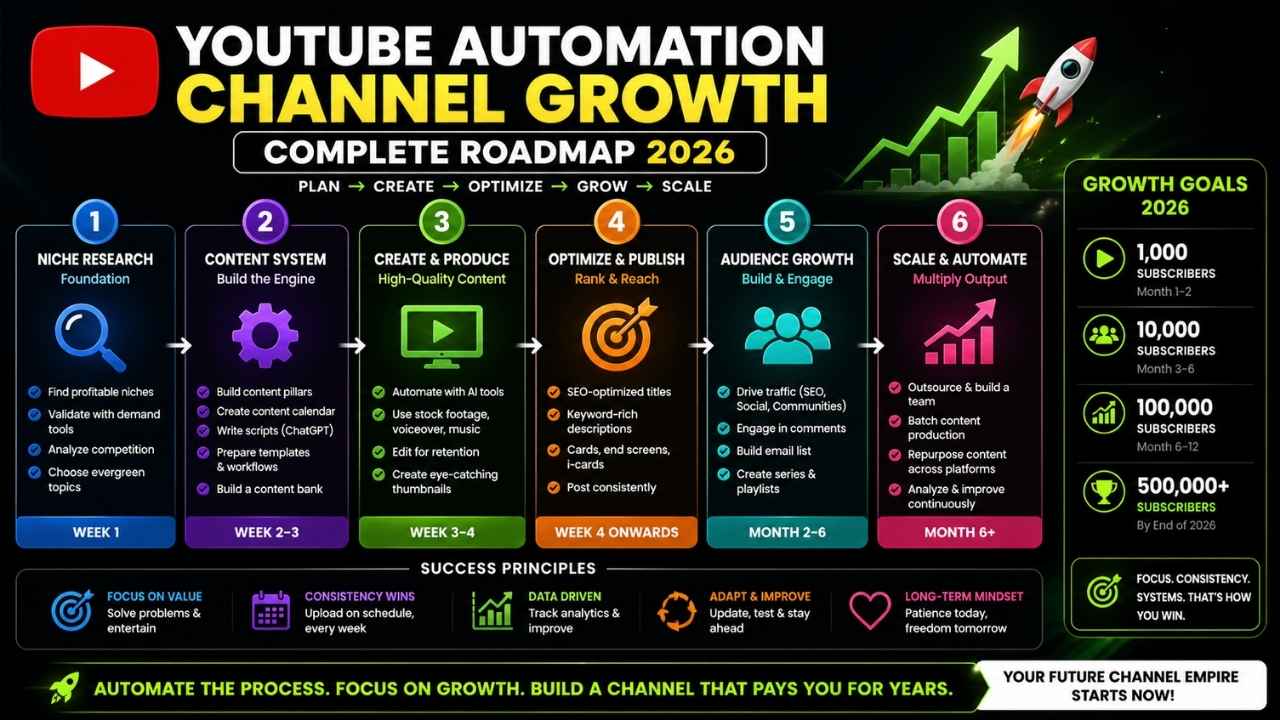
What if you could earn money on YouTube without ever showing your face, recording your voice, or spending hours in front of a camera? That is exactly what thousands of creators are doing right now with YouTube automation. In 2026, YouTube automation channel growth has become one of the most talked-about online business models in the world, and for good reason — it works. Whether you are a student, a stay-at-home parent, or someone looking for a side income, this model can change your financial life if you follow the right steps.
YouTube automation means building a channel where you outsource most of the work — scripting, voiceover, editing, and thumbnails — while you focus on strategy and growth. You act more like a business owner than a creator. This guide is your complete roadmap for 2026. It covers everything from picking a niche and setting up your channel, to hiring a team, optimizing for the YouTube algorithm, and scaling your earnings to a full-time income.
This is not a get-rich-quick article. It is a practical, step-by-step guide based on what is actually working in the real world right now. By the time you finish reading, you will know exactly what to do, in what order, and how to avoid the mistakes that kill most automation channels before they ever take off. Let us get started.
What Is YouTube Automation?
YouTube automation is a business model where you create and grow a YouTube channel without personally producing every piece of content. Instead of doing everything yourself, you build a small team of freelancers who handle the video creation process for you. Think of it like owning a restaurant — you do not cook every meal yourself, but you manage the kitchen, the menu, and the business strategy.
In a typical YouTube automation setup, you hire a scriptwriter to research and write video scripts, a voice artist (or use AI voiceover tools) to narrate the script, a video editor to put the footage together, and a thumbnail designer to create eye-catching covers. You focus on choosing the right topics, reviewing the content, and growing the channel strategically.
This model is sometimes called a faceless YouTube channel because the channel owner rarely appears on screen. The content is usually made up of stock footage, animations, screen recordings, or AI-generated visuals, paired with a clear and engaging voiceover. These channels cover topics like finance, history, true crime, self-improvement, health, science, and much more.
Why YouTube Automation Still Works in 2026
Some people wonder if it is too late to start a YouTube automation channel. The honest answer is no — in fact, 2026 may be the best time yet. Here is why.
YouTube’s Growth Is Unstoppable
YouTube has over 2.7 billion monthly logged-in users worldwide. People watch more than a billion hours of video on the platform every single day. The appetite for video content is growing, not shrinking. As more people cut their cable TV subscriptions and shift to online streaming, YouTube becomes even more powerful. There is more room for creators now than there has ever been.
AI Tools Have Made Automation Cheaper and Faster
In 2026, AI-powered tools have completely changed the game for automation channel owners. You can now use tools like ChatGPT to help with research and scripting, ElevenLabs or Murf AI for realistic voiceovers, and Pictory or InVideo AI for automated video creation. These tools have reduced the cost of producing each video and cut production time dramatically. What used to take a week can now be done in a day.
Monetization Options Have Expanded
Beyond AdSense, YouTube automation channels in 2026 can earn money through affiliate marketing, sponsored content, digital product sales, Patreon memberships, and YouTube’s own monetization features like channel memberships and Super Thanks. This means your income is not tied to one single source, which makes the business much more stable and scalable.
Step 1 — Choosing the Right Niche for Your Automation Channel
Your niche is the most important decision you will make when starting a YouTube automation channel. A good niche has three qualities: strong viewer demand, decent advertiser interest (which affects how much you earn per thousand views), and manageable competition so a new channel can still break through.
High-RPM Niches to Consider in 2026
Here are some of the best-performing niches for automation channels right now:
- Personal finance and investing (very high advertiser demand)
- Health, wellness, and mental health
- Technology reviews and AI tools
- True crime and mystery stories
- Motivational and self-improvement content
- History and educational documentaries
- Business ideas and entrepreneurship
- Science and space exploration
- Luxury lifestyle and travel
- Legal education and life advice
The RPM (Revenue Per Mille) in finance and business channels can range from $10 to $40 per thousand views, compared to entertainment channels that may only earn $2 to $5. Choosing a high-value niche does not guarantee success, but it does mean that every view you earn is worth much more to your bottom line.
How to Validate Your Niche Before You Commit
Before you build your entire channel around a niche, do your homework. Search YouTube for that niche and see how many channels exist. Look for channels with under 100,000 subscribers that are still getting consistent views — that tells you the topic has demand without being completely saturated. Use tools like VidIQ or TubeBuddy to check keyword search volume and competition scores. If you find topics with high search volume and low competition, you have found a golden opportunity.
Step 2 — Setting Up Your Channel the Right Way
Once you have chosen your niche, it is time to set up your channel properly. Many beginners skip this step or rush through it. Do not make that mistake. Your channel’s brand and setup will affect how viewers and advertisers see you from day one.
Channel Name, Logo, and Branding
Choose a channel name that is short, easy to remember, and gives a hint of what your channel is about. Avoid using your real name unless you plan to build a personal brand. For a finance channel, something like “Wealth Explained” or “Smart Money Lab” works well. Your logo and banner should look professional and clean. If you do not have design skills, use Canva’s free templates or hire a designer on Fiverr for as little as $10 to $20.
Writing a Strong Channel Description and Adding Keywords
Your channel description tells YouTube and potential subscribers what you are about. Write two to three clear sentences explaining who your channel is for and what kind of content you produce. Include your main niche keywords naturally in this description — this helps YouTube categorize your channel and show it to the right audience. Also, fill in your channel tags with relevant keywords related to your niche.
Step 3 — Building Your Content Production Team
This is where YouTube automation channel growth really separates itself from traditional YouTube. You are building a system, not just making videos. Your team does not need to be large — even one or two reliable freelancers can help you produce consistent, high-quality content.
Finding and Hiring a Scriptwriter
A great script is the backbone of your video. Without a strong, well-researched, and engaging script, even the best editor cannot save a boring video. Look for scriptwriters on Upwork, Fiverr, or PeoplePerHour who have experience writing for YouTube. Ask for writing samples in your niche. A good scriptwriter should be able to deliver videos that hold the viewer’s attention from the first five seconds all the way to the end, because watch time is one of the most important ranking factors on YouTube.
Voiceover: Human or AI?
In 2026, both options work, but each has its pros and cons. Human voiceover artists from platforms like Voice123 or Voices.com deliver natural-sounding, emotionally engaging narration that viewers tend to connect with better. AI voice tools like ElevenLabs, Murf AI, or Play.ht are much cheaper and faster, and the quality has improved dramatically. For channels just starting out, AI voiceover is a cost-effective way to keep production costs low while still delivering a professional sound.
Hiring a Reliable Video Editor
Your editor brings everything together. They take the script, the voiceover, and the stock footage and combine them into a finished, watchable video. When hiring an editor, look for someone who understands the YouTube style — good pacing, relevant b-roll footage, clear on-screen text, and smooth transitions. Pay attention to how quickly they deliver work and whether they are easy to communicate with. Consistency and reliability matter more than perfection in the early stages.
The Power of a Great Thumbnail Designer
On YouTube, your thumbnail is your advertisement. It is the first thing viewers see before they decide to click. Studies show that click-through rate (CTR) is one of the biggest factors in how YouTube pushes your video to new audiences. A strong thumbnail should have a bold, easy-to-read title, a clear focal image, and high-contrast colors that stand out on any device. Hire a thumbnail designer who understands your niche and can produce consistently clickable designs.
Step 4 — Creating Videos That the YouTube Algorithm Loves
Understanding how the YouTube algorithm works is not optional — it is essential. The algorithm decides which videos get pushed to more viewers and which ones disappear into obscurity. Fortunately, the main things YouTube cares about are not complicated.
Watch Time and Audience Retention
YouTube wants people to keep watching. The longer viewers watch your videos, the more YouTube rewards you with recommendations. Aim for an audience retention rate above 40 to 50 percent. To achieve this, make sure your scripts get to the point quickly, avoid long intros, and keep the content moving at a good pace. Use pattern interrupts — sudden changes in music, visuals, or tone — to re-engage viewers every 30 to 60 seconds.
Improving Your Click-Through Rate (CTR)
CTR is the percentage of people who see your video thumbnail and actually click on it. A CTR between 4 and 10 percent is considered good. Improving your CTR means testing different thumbnail styles, writing compelling titles with powerful words like “Why,” “How,” “Revealed,” or “You Won’t Believe,” and making sure your title and thumbnail work together to create curiosity without being misleading.
YouTube SEO: Titles, Descriptions, and Tags
YouTube is the second largest search engine in the world. That means video SEO is a real and important discipline. Use your main keyword in your video title, as close to the beginning as possible. Write a long, detailed video description — at least 200 to 300 words — that naturally includes your focus keyword and related terms. Use 10 to 15 relevant tags that include both broad and specific keyword phrases. Add closed captions to your videos, because YouTube reads your captions and uses them to understand what your video is about.
Step 5 — Uploading Consistently and Building Momentum
Consistency is the single most underrated factor in YouTube automation channel growth. The YouTube algorithm rewards channels that upload regularly. You do not need to post every day, but you should aim for at least one or two videos per week, especially in the early months. Think of each video as a long-term asset — it will keep getting views and earning money for months or even years after you upload it.
Set up a content calendar to plan your video topics at least two to four weeks in advance. This prevents the last-minute panic that causes many channels to become inconsistent. Your calendar should include the video topic, target keyword, deadline for each team member, and scheduled publish date. Treat your channel like a media company with real deadlines and real systems.
Step 6 — Monetization Strategies for Your Automation Channel
Once your channel starts gaining traction, it is time to think seriously about how to monetize it. There are several powerful income streams available to YouTube automation channel owners.
YouTube Partner Program (AdSense)
To join the YouTube Partner Program, you need 1,000 subscribers and either 4,000 watch hours in the past 12 months or 10 million Shorts views. Once approved, YouTube places ads on your videos and pays you a share of the revenue. The amount you earn per thousand views (RPM) depends heavily on your niche, your audience’s location, and the time of year. Finance, business, and tech channels consistently earn the highest RPMs.
Affiliate Marketing: A Powerful Revenue Booster
Affiliate marketing is often where automation channels make their biggest money. You recommend products or services in your videos and include special tracking links in your description. When a viewer clicks your link and makes a purchase, you earn a commission. Finance channels can promote investing apps, brokerage accounts, and financial tools that pay $30 to $200 per referral. Health channels can promote supplements, fitness equipment, or wellness apps. Choose affiliate programs that are genuinely useful to your audience and always disclose your affiliate relationships.
Brand Sponsorships and Paid Promotions
As your channel grows, brands will start reaching out to you for paid sponsorships. A channel with 50,000 subscribers in the finance niche can charge between $500 and $2,000 per sponsored segment. You can also proactively pitch brands that align with your audience. Use platforms like Grapevine, AspireIQ, or Creator.co to connect with sponsors. Always make sure the products or services you promote are ones you would genuinely recommend, because your audience’s trust is your most valuable asset.
Step 7 — Analyzing Performance and Scaling Your Channel
Growing a YouTube automation channel is not just about uploading videos and hoping for the best. You need to look at your data regularly and make decisions based on what it tells you. YouTube Studio provides detailed analytics that show you exactly how your videos are performing.
Key Metrics Every Automation Channel Owner Should Track
- Click-Through Rate (CTR): Aim for 4% or higher. If it’s lower, test new thumbnail styles.
- Average View Duration: The longer viewers watch, the better. A 50% retention rate is excellent.
- Impressions: How many times YouTube showed your thumbnail. Higher impressions mean the algorithm is testing your video.
- Subscriber Growth Rate: Track how many new subscribers each video brings in.
- Revenue Per Mille (RPM): Understand which topics earn the most money per thousand views.
- Traffic Sources: Know whether viewers find you through search, suggested videos, or external sources.
Double Down on What Works
When you notice a video performing significantly better than your others — higher views, better retention, more comments — that is a signal from the algorithm. Find out why it worked. Was it the topic? The title format? The thumbnail style? Then create more videos using a similar approach. Successful YouTube automation channel growth is about finding patterns in your data and repeating what works while dropping what does not.
Common Mistakes That Kill YouTube Automation Channels
Many beginners make the same avoidable mistakes. Here are the most common ones to watch out for:
- Choosing a niche without researching demand or RPM potential.
- Hiring the cheapest freelancers available and expecting high-quality results.
- Uploading inconsistently and then wondering why the channel is not growing.
- Ignoring YouTube analytics and continuing to make the same type of underperforming videos.
- Using copyrighted music or footage without proper licensing, which can lead to strikes.
- Expecting overnight success — most channels take three to six months to gain real traction.
- Not reinvesting early ad revenue back into the channel for better production quality.
- Copying other channels’ content directly instead of putting an original spin on topics.
Best Tools for YouTube Automation Channel Growth in 2026
Having the right tools makes your operation faster, cheaper, and more professional. Here is a breakdown of the essential tools for each stage:
- Research and SEO: VidIQ, TubeBuddy, Google Trends, Ahrefs YouTube Keyword Tool.
- Scriptwriting Assistance: ChatGPT-4o, Claude AI, Jasper AI.
- AI Voiceover: ElevenLabs, Murf AI, Play.ht, Speechify.
- Video Creation: InVideo AI, Pictory, Adobe Premiere Pro, DaVinci Resolve.
- Thumbnail Design: Canva Pro, Adobe Photoshop, Snappa.
- Project Management: Trello, Notion, Asana — for managing your content team.
- Freelancer Platforms: Upwork, Fiverr, PeoplePerHour.
- Music and Sound: Epidemic Sound, Artlist, YouTube Audio Library.
How Long Does It Take to Grow a YouTube Automation Channel?
This is the question everyone wants answered. The truth is, it depends on several factors: your niche, your content quality, your upload frequency, and a little bit of luck. That said, here is a realistic timeline based on channels that follow the strategies in this guide.
- Months 1 to 2: Setting up the channel, building your team, and publishing your first 8 to 10 videos. You may see very little traffic at this stage. This is completely normal.
- Months 3 to 4: YouTube begins testing your videos with small audiences. You might hit your first 100 to 500 subscribers. Some videos may start getting steady views from search.
- Months 4 to 6: If your content is good and consistent, this is often when things start to accelerate. You may hit 1,000 subscribers and qualify for monetization.
- Months 6 to 12: A well-run automation channel in a solid niche can reach 5,000 to 20,000 subscribers and start generating meaningful ad revenue, often between $500 and $3,000 per month.
- Year 2 and Beyond: Channels that stay consistent and keep improving often reach 50,000 to 100,000 subscribers and earn $5,000 to $20,000 or more per month from multiple income streams.
Patience is not optional in this business. The channels that succeed are the ones that show up every week, make small improvements based on data, and do not quit when early growth is slow.
Real-World Income Expectations: What Can You Actually Earn?
Let us be completely transparent about income potential, because too many people in this space oversell the numbers. Yes, there are YouTube automation channel owners making $10,000, $30,000, or even $100,000 per month. But these are established channels with tens of thousands of subscribers, large teams, and multiple income streams that they have built over years.
A realistic expectation for someone starting from scratch is to see their first $100 to $500 in monthly revenue within six to nine months, assuming consistent uploads and a decent niche. From there, with smart reinvestment and optimization, $1,000 to $3,000 per month within 12 to 18 months is very achievable. According to research published by Influencer Marketing Hub, the average YouTube channel earns between $3 and $5 per 1,000 views, though finance and business channels earn significantly more. You can read more about YouTube earnings data at Wikipedia’s page on YouTube monetization: https://en.wikipedia.org/wiki/YouTube#Monetization.
Keeping Your Channel Safe: Rules, Policies, and Best Practices
YouTube takes its community guidelines and copyright policies very seriously. One violation can result in a strike against your channel, and three strikes means permanent deletion. Here are the most important safety rules for automation channel owners.
- Never use copyrighted music without a license. Stick to royalty-free sources like Epidemic Sound or YouTube’s own audio library.
- Do not use stock footage that you do not have the rights to. Use licensed platforms like Storyblocks, Pexels, or Pixabay.
- Avoid misleading titles or thumbnails, known as clickbait. YouTube penalizes videos that promise something they do not deliver.
- Always disclose sponsored content and affiliate links as required by FTC guidelines.
- Do not purchase fake views, likes, or subscribers. YouTube actively detects and penalizes artificial engagement.
- Read YouTube’s monetization policies carefully before creating content to make sure your topic and style are eligible for ads.
Advanced Strategy: Scaling to Multiple Automation Channels
Once your first channel is stable and generating consistent income, many successful automation channel owners start a second or even third channel in a different niche. This is the real power of the automation model — because you already have the systems and team in place, launching a new channel requires relatively little extra effort. You can reuse the same editor, the same thumbnail designer, and the same production workflow on a new channel in a completely different niche.
Some advanced automation channel operators run four to six channels simultaneously, each in a different niche, each generating its own ad revenue and affiliate income. When done well, this creates a diversified YouTube business that is not dependent on any single channel or niche performing perfectly.
The Future of YouTube Automation Beyond 2026
The YouTube automation landscape will continue to evolve. AI tools will become even more capable and affordable. YouTube itself will continue to roll out new monetization features and creator tools. Short-form video through YouTube Shorts will grow in importance as a discovery mechanism that feeds viewers to your long-form content.
The creators who will win in 2027, 2028, and beyond are the ones who treat their channels as real businesses. They will continue to invest in quality, build genuine audiences who trust them, and adapt their strategy as the platform changes. The automation model is not just a 2026 trend — it is a business framework that will remain relevant for as long as YouTube exists.
Final Thoughts
YouTube automation channel growth in 2026 is one of the most accessible and scalable online business models available today. You do not need a big team to start, you do not need to be on camera, and you do not need any prior YouTube experience. What you do need is a clear strategy, a commitment to consistency, a willingness to learn from your data, and the patience to build something real over time.
This roadmap has given you everything you need to go from zero to a fully functioning, growing YouTube automation channel. Now it is time to take action. Pick your niche today. Set up your channel this week. Hire your first freelancer this month. Every big channel in this space started exactly where you are right now — at the beginning. The only difference between those who succeed and those who do not is that the successful ones kept going.
Your journey to YouTube automation channel growth starts today. Make it count.
Frequently Asked Questions (FAQs)
Q1. How much money do I need to start a YouTube automation channel?
No, YouTube automation is perfectly legal and allowed under YouTube’s terms of service. YouTube does not require creators to produce all of their own content personally. What YouTube does prohibit is uploading content that violates copyright, misleads viewers, or uses fake engagement. As long as your content is original and follows YouTube’s community guidelines, automation channels are fully compliant.
Q2. Do I need to show my face or use my own voice?
No. That is the whole point of a faceless YouTube automation channel. The content is narrated by a voiceover artist or AI voice tool and illustrated with stock footage, animations, or screen recordings. The channel owner never needs to appear on camera or record their own voice.
Q3. Is YouTube automation against YouTube’s terms of service?
A copyright strike happens when you use someone else’s licensed material without permission. A reused content strike happens when you re-upload someone’s video without significant original contribution. Both are serious violations.
Q4 What is the best niche for a YouTube automation channel in 2026?
The best niches in 2026 are personal finance, self-improvement, technology and AI tools, health and wellness, and business education. These niches have high advertiser demand, which translates to a high RPM. However, the best niche for you is also one that has enough topics to sustain regular content production over the long term.
Q5. How long does it take to reach 1,000 subscribers with an automation channel?
For most automation channels uploading one to two videos per week with solid SEO and quality content, reaching 1,000 subscribers takes between four and eight months. Some channels in high-demand niches with exceptional content have reached it faster, in two to three months. Channels that upload inconsistently or produce low-quality content may take much longer.





1 thought on “YouTube Automation Channel Growth: Complete Roadmap 2026”