
Most freelancers spend weeks fixing their portfolio, rewriting their bio, and tweaking their rates — then wonder why clients still don’t respond.
The problem usually isn’t the portfolio. Or the rates.
It’s that they don’t understand how a client actually thinks when they’re deciding who to hire. And nobody really talks about this part clearly.
I’ve been on both sides. I’ve hired people for projects, and I’ve been hired as a freelancer. That experience taught me a lot about what clients look for before hiring — and how different it is from what most freelancers assume.
The First Thing Clients Check Is Trust, Not Talent
This surprises a lot of people. Most freelancers think clients care most about skill. They go and build elaborate portfolios, list every tool they know, and write long bios about their experience.
But the first thing a client feels — before they even read your bio — is: can I trust this person?
That feeling comes from small signals. Things like:
- Does this profile look real and complete?
- Does this person communicate clearly?
- Do they seem like someone who will actually deliver?
A client who needs a logo designed doesn’t care that you know 12 software tools. They care that you’ll get them a good logo on time without drama.
Trust is the foundation. If a client doesn’t feel it, they move on — even if your work is great.
What Clients Look for Before Hiring: The Real List
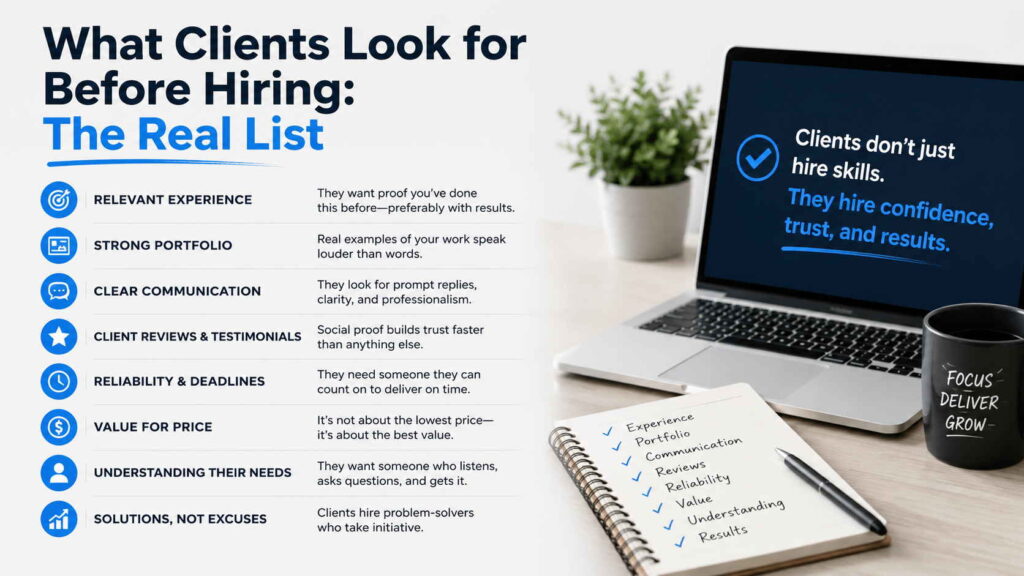
1. Proof That You Can Do the Specific Thing They Need
“I’m a designer” is not enough. “I design landing pages for online stores” is much better.
Clients want to see work that is close to what they need. If someone is looking for help writing product descriptions for a food brand, they’re not impressed by your blog post portfolio. They want to see food writing, e-commerce writing, something close.
This is why a smaller, focused portfolio usually beats a big general one.
A lot of beginners think showing more work makes them look more experienced. Sometimes it does the opposite — it makes it hard for the client to find what they actually care about.
Practical tip: If you’re reaching out to a specific type of client, move the most relevant work to the top. Don’t make them dig.
2. Clear Communication From the Very First Message
The way you write your first message or proposal tells the client a lot.
If it’s vague, full of spelling mistakes, or clearly copy-pasted — they notice. Most clients read the first few lines and already form an opinion.
What works:
- Show that you actually read their brief or understood their problem
- Write short, clear sentences
- Get to the point fast
What doesn’t work:
- Long intros about yourself that the client didn’t ask for
- Vague sentences like “I can help you with all your needs”
- Starting with “Dear Sir/Madam” when their name is right there
One thing I noticed when hiring people: the ones who sent short, specific messages almost always performed better than the ones who sent long, polished-sounding proposals. Clear communication is a skill. Clients can spot it early.
3. Some Kind of Social Proof
Social proof just means: other people said this person is good.
It could be:
- A written review or testimonial from a past client
- A star rating on a platform
- A mention on LinkedIn
- Even a casual quote like “Alex helped us fix our website — highly recommend”
When there are no reviews at all, clients feel unsure. They’re taking a risk on you. A little proof goes a long way to lower that risk.
If you’re just starting out and have no reviews yet, here’s what you can do:
- Offer one small project at a reduced rate in exchange for honest feedback
- Ask past employers or coworkers to write a short recommendation on LinkedIn
- Do a spec project (a made-up example of real work) and share it with an honest label — “practice project, not for a real client”
Don’t fake reviews. Ever. Clients are more perceptive than you’d think, and fake-sounding testimonials hurt more than no testimonials.
4. A Price That Feels Reasonable for the Value
This is tricky. Clients aren’t always looking for the cheapest option — but they do want to feel like they’re getting good value.
Pricing too low can actually scare clients away. It sounds strange, but if your rate is way below everyone else, clients sometimes wonder why. Is the quality bad? Does this person not know what they’re doing?
Pricing too high without clear reasons for it also pushes clients away. They need to understand what they’re paying for.
The sweet spot is: a price that feels fair for the result they’ll get, with enough clarity that they understand what they’re buying.
When you say “I charge Xtodesignalandingpage,andhere′swhatthatincludes,”it′smucheasierforaclienttosayyesthanwhenyoujustsay”X.”
5. Responsiveness — Even Before the Project Starts
Clients pay attention to how fast you reply during the hiring process.
If they send you a question and you take four days to answer, they’ve already moved on — or they’re worried you’ll be slow during the actual project.
You don’t need to be glued to your phone. But replying within 24 hours during business days is a reasonable standard. During active discussions, faster is better.
One common mistake: going quiet after sending a proposal. Following up once, politely, after a few days is completely acceptable. Clients get busy. A short “just checking if you had any questions” message has won me work more than once.
6. A Personality That’s Easy to Work With
Clients spend money on freelancers, yes — but they also spend time and energy. If working with you feels difficult or stressful, that’s a cost too.
They’re looking for someone who:
- Asks smart questions when something isn’t clear (instead of guessing wrong)
- Takes feedback well, without getting defensive
- Doesn’t over-promise and then underdeliver
- Is honest when they don’t know something
You don’t have to be the most talented person in the room. But if you’re easy to work with and reliable, clients will come back and refer you to others. That’s how real freelance businesses grow.
7. A Clear Process or Next Step
A lot of freelancers lose clients simply because the next step is unclear.
When a client reads your proposal and thinks “so… what happens now?” — there’s friction. Friction leads to delay. Delay leads to them finding someone else.
Make it simple. Tell them exactly what happens after they say yes:
- “Once you confirm, I’ll send a short intake form to understand your project better.”
- “After that, I’ll send a rough draft within 5 business days.”
That kind of clarity feels professional and reduces the client’s anxiety about the unknown.
The Hidden Stuff Clients Notice But Never Mention
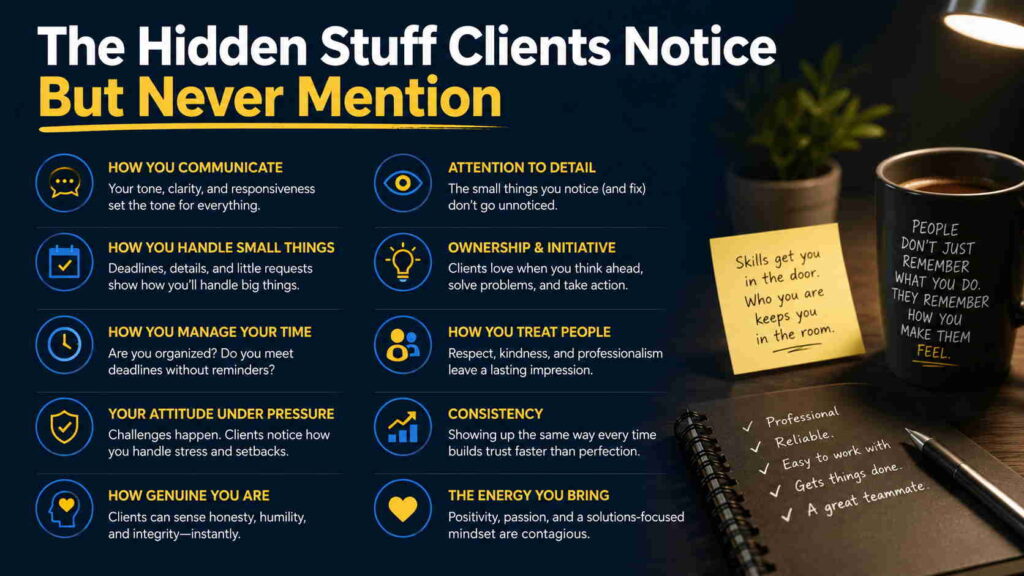
Some things clients won’t say out loud, but they are quietly deciding based on them:
Your online presence. Even if you’re not applying through a platform, clients often Google you. A LinkedIn profile that looks abandoned, an Instagram full of unrelated personal content, or nothing at all can make them hesitate.
Spelling and grammar. Not because clients are grammar teachers, but because it signals attention to detail. If your proposal has three typos, they wonder what your work will look like.
How you handle a “no” or a negotiation. If you push too hard on price or get upset when they want a revision — that tells them everything. Clients sometimes test this, consciously or not.
Whether you seem interested in their actual problem. The freelancers who ask a specific question about the project — one that shows they actually thought about it — stand out quickly. “I noticed your site uses Shopify — should the landing page follow that same style?” is the kind of question that makes a client feel heard.
A Quick Comparison: What Clients Say vs. What They Actually Mean
| What They Say | What They Often Mean |
|---|---|
| “We need someone experienced” | “We don’t want to babysit you” |
| “Our budget is flexible” | “We have a number in mind, impress us” |
| “We’ll know it when we see it” | “We haven’t fully defined the problem yet” |
| “Can you do a quick test?” | “We want to see how you work under pressure” |
| “We need this ASAP” | “We left this too late and are stressed” |
Understanding the real meaning behind what clients say helps you respond in a way that actually addresses their concern — not just the surface question.
What to Fix First If You’re Not Getting Hired
If clients aren’t hiring you, run through this checklist:
- Does your profile or portfolio clearly show what you do and for whom? If not, that’s the first thing to fix.
- Does your outreach or proposal mention their problem, not just your skills? Most proposals are too “me” focused.
- Do you have at least one real testimonial or proof of work? If not, make getting that your priority.
- Is your response time fast enough? Slow replies kill deals.
- Is your pricing explained, not just listed? “Here’s what you get for this price” is more convincing than just a number.
Fix one thing at a time. Changing everything at once makes it hard to know what actually helped.
Conclusion
Getting hired comes down to more than skill. Clients are looking for someone they can trust, someone who communicates well, and someone who makes the whole process feel easy.
The freelancers who keep getting work — and get referrals — are usually not the most talented ones in the room. They’re the ones who show up reliably, communicate clearly, and make clients feel like they made a good decision.
Focus on those things, and the portfolio and rates will matter a lot more.
Read More: How I Got My First Freelance Client Without Upwork
FAQ
Q: Do clients care more about price or quality?
Most clients are balancing both. They want good work at a reasonable price. Very cheap often worries them. Very expensive needs justification. The key is making the value clear./p>
Q: What if I have no portfolio or reviews yet?
Start with one small project, even a practice one. A single strong piece of work with a clear explanation beats a long list of vague claims. For reviews, ask a past employer or colleague to write a short LinkedIn recommendation.
Q: How important is a professional website?
For many freelancers, a LinkedIn profile and a simple portfolio page (even a free one on Behance, Notion, or Carrd) is enough. A fancy website isn’t required. Clarity is what matters.
Q: Why do clients ghost after seeing my proposal?
Usually one of three reasons — price felt off, proposal wasn’t specific enough to their project, or they found someone faster. A polite follow-up after 3–5 days is worth trying.
Q: How do I stand out when I’m competing with many other freelancers?
Specificity. The more clearly you can say “I do X for Y type of businesses and here’s proof,” the less competition you actually have. Most freelancers are too general. Niching down, even slightly, helps a lot.