Most freelancing advice starts with “sign up for Upwork.” And look — that platform works for some people. But when I was starting out, I spent three weeks writing proposals into what felt like a black hole. One response. It was lowball. I passed.
So I decided to stop treating platforms like they were the only answer, and within about six weeks, I had my first real paying client. No bidding. No race to the bottom on price. Here’s what that actually looked like.
Why Platforms Make It Harder Than It Needs to Be
Upwork, Fiverr, Freelancer — they’re built around volume and competition. You’re not just competing with other beginners in your city. You’re up against people charging $8 an hour from different parts of the world, who already have 200 five-star reviews.
Getting your first freelance client through those platforms when you have zero reviews is genuinely hard. The algorithm doesn’t trust you yet, clients filter by reviews, and you end up either pricing yourself too low to be sustainable or getting ignored entirely.
The other issue: you’re a commodity on those platforms. Every client sees ten profiles that look like yours. There’s no real relationship before the transaction.
Going off-platform forces you to do something slightly scarier but way more effective — actually talk to people.
What I Did Instead
I Started With My Existing Network (Seriously, Don’t Skip This)
The advice to “tell people you know” sounds too simple to be useful. I ignored it for weeks. That was a mistake.
When I finally sent a handful of direct messages to former coworkers, college contacts, and even a couple of people I’d met at one-off networking events, something happened: two of them actually knew someone who needed help.
I wasn’t asking for charity. I framed it specifically:
“Hey — I’ve started doing freelance [web design / copywriting / whatever]. If you ever hear of someone who needs help with X, I’d appreciate the referral. Here’s a quick look at what I do.”
That’s it. No long pitch. No portfolio PDF attached. Just a short, human message.
One of those contacts connected me with a small business owner who needed her website rewritten. That became my first paid project.
The thing most people miss is that their network doesn’t know what they do unless they say it clearly. Nobody’s going to volunteer “hey, you should freelance” — you have to tell them you’re available.
I Picked a Narrow Target and Went Direct
After that first project, I needed a repeatable strategy. Waiting on referrals isn’t reliable.
What worked: I picked a very specific type of business — small local service businesses (plumbers, electricians, landscapers) that had obviously outdated or missing websites — and I started reaching out directly.
Not through a platform. Through email.
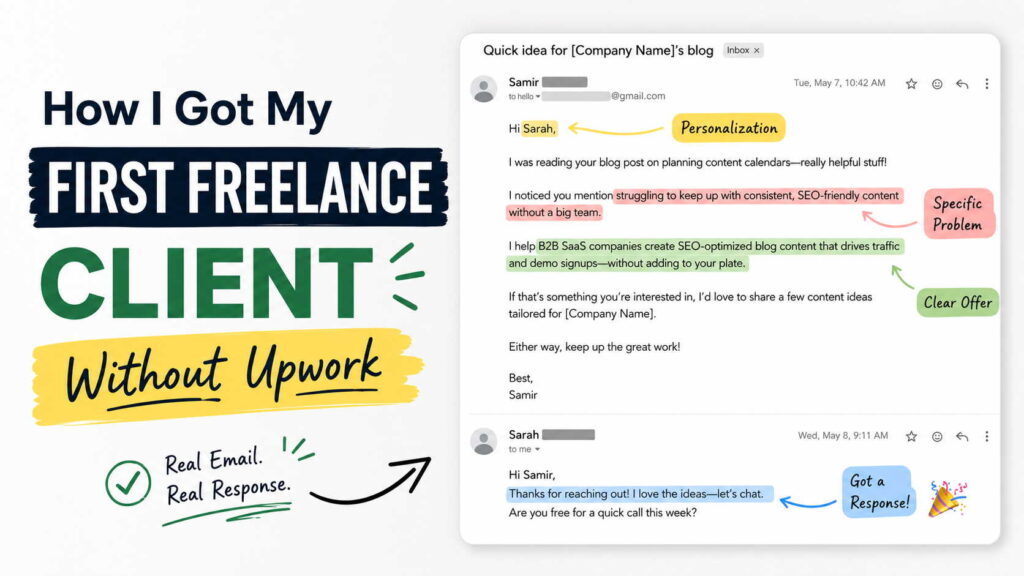
Here’s what my outreach looked like in practice:
- Find a business with a weak online presence (bad site, no site, no Google reviews)
- Write a short, specific email pointing out one concrete problem and offering a solution
- No generic pitch. Reference their specific business.
Example opening:
“Hi [Name] — I came across [Business] while looking for a local electrician. Noticed your site hasn’t been updated in a while and doesn’t show up in local search. I help small businesses like yours fix that. Want me to send over a few quick observations?”
Response rates were low — maybe 10–15%. But at that level of specificity, even a few responses turn into conversations, and conversations turn into clients.
I Used LinkedIn — But Not the Way Most People Do
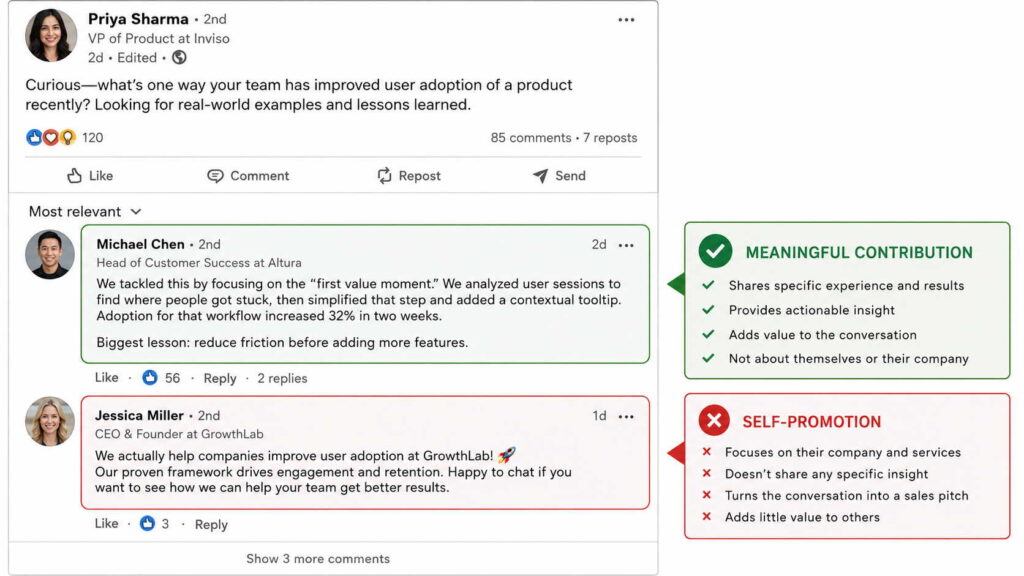
Cold DMs on LinkedIn mostly don’t work because everyone sends the same “Hi [Name], I noticed your company does X and I’d love to connect about Y” message. It gets ignored.
What worked better: I started contributing to actual conversations. Commenting meaningfully on posts from people in my target industry. Sharing one or two specific insights about problems I’d seen. No self-promotion in those comments — just genuinely useful input.
Over about a month, a few people started following me. One messaged me asking if I did consulting work.
It’s slow. But it compounds. And it positions you as someone worth talking to rather than someone who needs a favor.
I Created One Piece of Content That Showed My Work
I didn’t build a full portfolio from scratch. I didn’t have the work to fill one.
Instead, I did one spec project — a fictional redesign of a local business website — and wrote a short post about my process. Why I made the design choices I did. What I would have changed about their existing site. What results a business like that could reasonably expect.
Posted it on LinkedIn. Shared it in one relevant Facebook group for small business owners. That was it.
It wasn’t viral. But a few people read it, and one reached out asking if I’d done work like that for real clients. Told her I was getting started and offered a reduced rate for the first project in exchange for a testimonial. She agreed.
That project became my second piece of actual portfolio work — and the testimonial helped close the next three clients.
The Mistakes I Made Along the Way
Waiting until my portfolio was “ready.” There’s no ready. You build the portfolio by doing the work, not before it.
Pricing too low thinking it would get me clients faster. It didn’t. It attracted clients who wanted something for nothing and were difficult to work with. When I raised my rate, the quality of clients improved.
Sending the same generic outreach to 50 people. Almost no responses. When I slowed down and personalized each message, the conversion rate went up noticeably.
Not following up. A lot of people who don’t respond to a first message will respond to a second one sent a week later. I almost never followed up early on. That was leaving clients on the table.
What Platforms Are Actually Good For
This isn’t anti-Upwork. Platforms make sense in specific situations:
- If you need income immediately and have a very specific skill that’s in demand (certain dev skills, video editing, etc.)
- If you’re comfortable competing on price in the short term while building reviews
- If you want to test whether a niche is viable before going deeper
But for getting your first freelance client, especially if you’re newer to the game, direct outreach with a clear offer almost always beats a platform. You control the conversation, the pricing, and the positioning.
A Simple Starting Framework
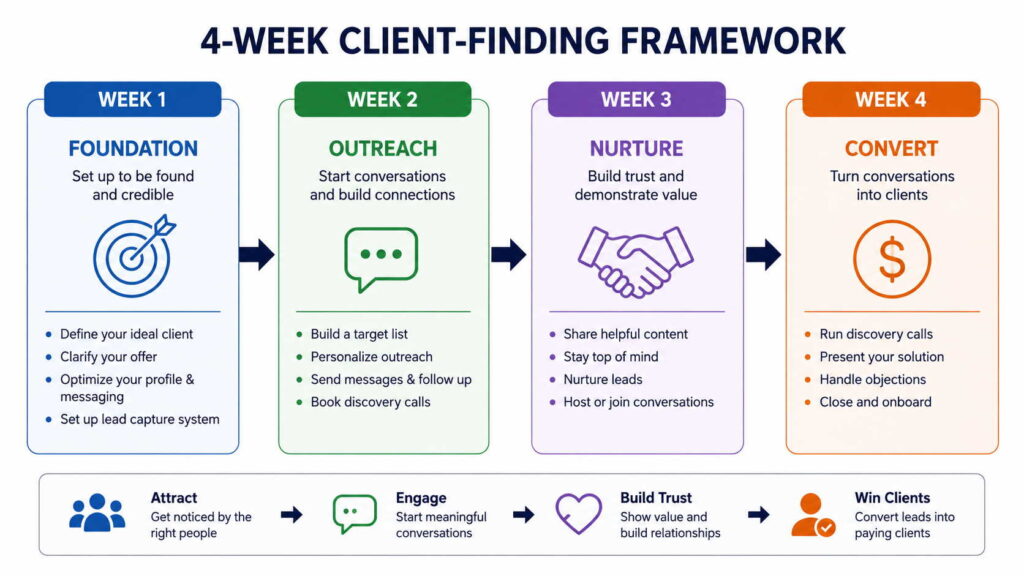
If you want to try this approach:
- Week 1: Message 10–15 people in your existing network. Be specific about what you do and who you help. Ask if they know anyone who needs it.
- Week 2–3: Identify 20–30 businesses in a niche you understand. Send personalized outreach with a specific observation about their situation.
- Week 3–4: Create one real or spec piece of work. Write briefly about your process. Share it in one relevant community.
- Ongoing: Contribute meaningfully in spaces where your potential clients spend time. LinkedIn, niche Facebook groups, forums, industry newsletters.
None of this is fast. The first client typically takes four to eight weeks of consistent effort. But it’s a better foundation than grinding through platform algorithms.
Read More : Winning Product Research Techniques for Dropshipping in 2026
FAQ
Q: Do I need a portfolio before reaching out to clients?
Not necessarily. One strong spec project is enough to start. Most clients care more about your ability to understand their problem than they do about a list of past projects./p>
Q: What if I have no network at all?
Most people underestimate how many people they actually know. Former coworkers, classmates, neighbors, family friends — start there. Even if none of them need your service directly, they might know someone who does.
Q: How many outreach emails should I send per day?
Quality over quantity. Five personalized, well-researched emails will outperform fifty generic ones. Aim for five to ten solid ones per week when you’re starting out.
Q: Should I work for free to build a portfolio?
Spec work is better than free work for real clients. Free work devalues your time and often leads to difficult clients. If you need portfolio pieces, create them yourself or offer a discounted “first project” rate in exchange for a testimonial.
Q: How do I handle pricing when I have no track record?
Price based on the value of the outcome for the client, not your experience level. Do the math on what solving their specific problem is worth to them. That’s your anchor. Then price somewhere reasonable relative to that — not near zero.